


Fachgebiet Nano- und Mikrofluidik
Herzlich willkommen am Fachgebiet Nano- und Mikrofluidik!
Wir beschäftigen uns mit Transportphänomenen in Fluiden auf der Nano- und Mikrometerskala. Dabei interessiert uns besonders die Erforschung von Grundlagen mit der Intention, den Weg für neuartige Anwendungen zu bereiten. Unser Ansatz beruht auf einer „Bottom-up“-Strategie, d. h. die Forschung ist erkenntnisgetrieben. Wissenschaftliches Neuland zu betreten fasziniert uns, aber dabei behalten wir Anwendungen im Blick. Diese können auf unterschiedlichen Gebieten wie beispielsweise Nachhaltigkeit, Energiewandlung, Verfahrenstechnik oder der (bio)chemischen Analytik liegen.
Unsere Forschung erstreckt sich über ein breites Themenspektrum und kombiniert experimentelle, theoretische und numerische Ansätze. Zu unseren Arbeitsgebieten gehören Gaskinetik auf der Nanoskala, Transportprozesse in Elektrolytlösungen und an Flüssigkeitsgrenzflächen, Benetzungsphänomene und Trennprozesse für Biomoleküle.
In der Lehre bieten wir Veranstaltungen auf Masterniveau an, in denen sich unser Forschungsansatz wiederspiegelt. Dies bedeutet, dass dem Verständnis von Phänomenen und Prozessen eine große Bedeutung zukommt, diese aber auch im Anwendungskontext betrachtet werden.
Falls wir Ihr Interesse geweckt haben, würden wir uns über eine Kontaktaufnahme freuen!


News

October 07, 2026
“Türen auf mit der Maus” – Making Flow Visible
On October 03, the Department of Mechanical Engineering at TU Darmstadt opened its doors for the annual “Türen auf mit der Maus” (“Doors Open with the Mouse”) event. Under the headline “Small Wonders, Big Impact,” our hands-on station invited children to explore the hidden motion of fluids. Using a rheoscopic fluid, the young researchers observed fascinating flow patterns: the von Kármán vortex street, which can form behind an obstacle, and the Rayleigh–Bénard instability, in which temperature differences give rise to characteristic flow patterns. Afterwards, the children filled small containers with their own rheoscopic fluid and took them home, ready to continue experimenting and exploring the nature of fluids. Around 300 children visited the campus that day. A big thank-you to all the young researchers who joined us!

October 1st, 2026
New group member: Orr Avni
Recently, Orr Avni joined our group as a postdoctoral researcher. He will study instabilities of fluid interfaces. Before coming to Darmstadt, he spent some time as a postdoc at Brown University.
Welcome Orr!

September 10, 2026
New group member: Evi Mylona
Recently, Evi Mylona joined our group as a PhD student. She will study the formation of self-organized or reconfigurable microchannel networks.
Welcome Evi!

June 29, 2026
A retrospective on a groundbreaking work
Many solutes are soluble in a variety of different liquids. A common scenario in numerous chemical engineering processes is a solute that is initially dissolved in one liquid and diffuses across a liquid-liquid interface. It has been known since the late 19th century that chemical fluxes between immiscible liquids trigger stirring fluid flows, but a mechanistic understanding of this phenomenon proved far more elusive. In 1959, a pioneering theoretical study by Sternling and Scriven revealed that solute fluxes induce interfacial ‘turbulence’ through local gradients of interfacial tension. Such processes play a role in the microscale transport phenomena we study in our group. A retrospective on the groundbreaking work of Sternling and Scriven has recently been published in the journal Nature Chemical Engineering.

June 29, 2026
Team led by Lisa Bauer receives honorable mention for equal opportunities initiative
Our colleague Lisa Bauer contributed significantly to the equal opportunities initiative of the Department of Mechanical Engineering at TU Darmstadt, which has now been recognized with an honorable mention under the TU Darmstadt Franziska Braun Award. The initiative, titled “Maschinenbau: fair, zukunftsfähig, weiblich”, was awarded for its strong commitment to fostering a modern, professional, and inclusive engineering culture. Congratulations to Lisa and the entire team involved in this important achievement!

June 08, 2026
Supplying engineered human tissue with oxygen
The development of large-scale, three-dimensional human tissues is crucial for therapeutic tissue engineering, disease modeling, and drug testing. Supplying the tissue with oxygen and nutrients remains a major challenge. Nature’s design to overcome this limitation is the hierarchical vascular network. However, many constraints under which the vascular network in the human body is formed do not apply to engineered tissue in the laboratory. Based on a mathematical model for oxygen supply and computational design studies, the Hardt and Nuber groups have jointly formulated design rules for artificial supply networks. The results were published in the journal Scientific Reports.

May 28, 2026
Aaron wins an award for his outstanding Ph.D. thesis “Electrokinetic Phenomena across Length Scales – from Nanofluidics to Sliding Drops”
Our former Ph.D. student Aaron Ratschow (now at the Max-Planck Institute for Polymer Research in Mainz) recently won the award for outstanding Ph.D. theses in Mechanical Engineering that is presented by the “Vereinigung von Freunden der Technischen Universität Darmstadt”. Congratulations Aaron, that’s a great achievement!
May 12, 2026
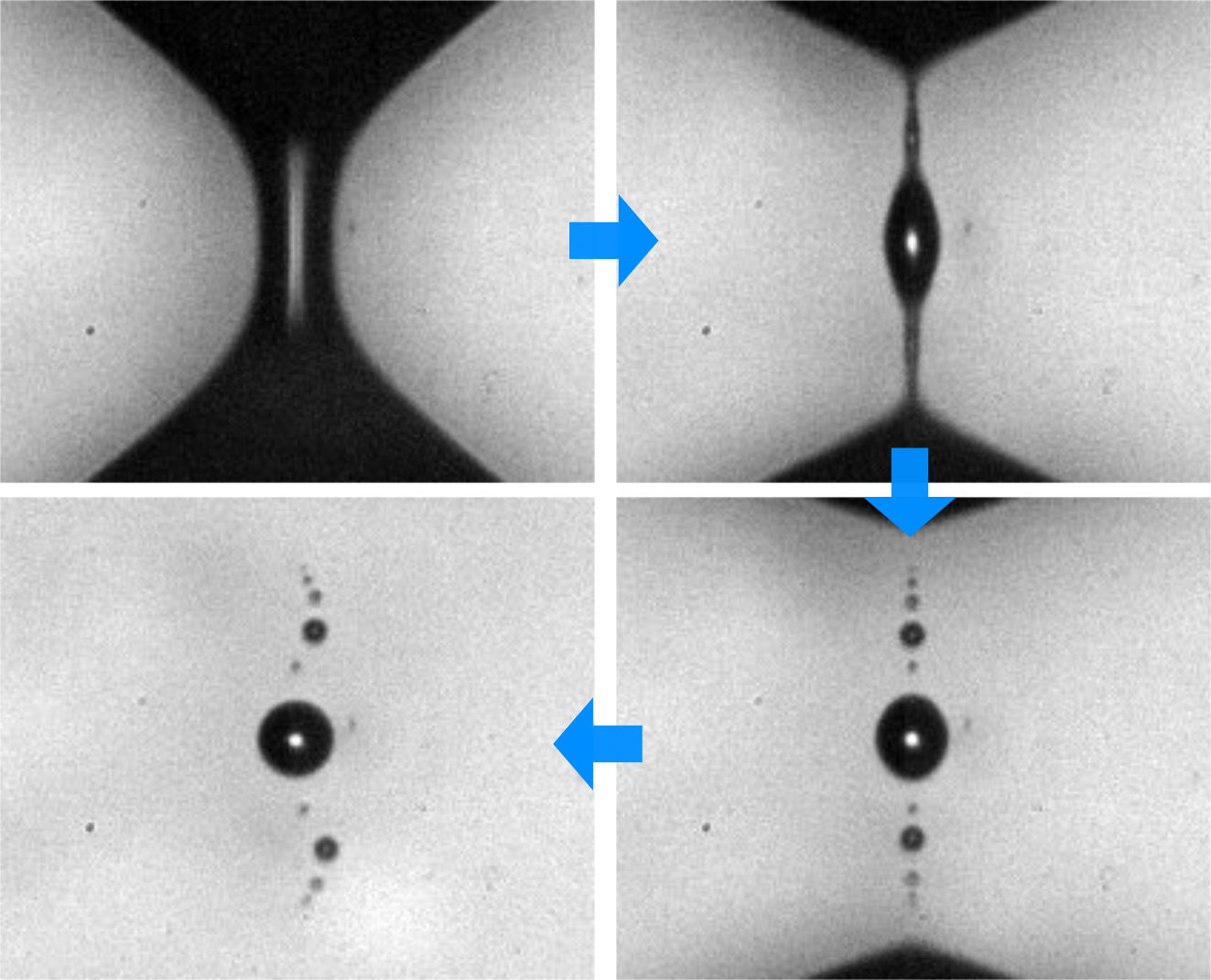
Electrostatic effects in dynamic wetting
Dynamic wetting processes are ubiquitous in nature and technology. Examples are coating or cleaning processes and oil recovery. In recent years, electrification of drops sliding along surfaces has gained significant attention. By studying the breakup of liquid bridges on surfaces, we have shown that slide electrification influences dynamic wetting beyond scenarios with drops. Our results, which were recently published as Editor’s Suggestion in the Journal Physical Review Fluids, suggest that slide electrification significantly influences the contact line friction in many dewetting processes.


April 23, 2026
Girls' Day – A Hands-On Crash Course for Future Scientists
On April 23, our group participated in Girls' Day. Eight talented girls joined our program and gained insight into what it takes to be a scientist. Our future scientists received a hands-on crash course in fluid dynamics. They learned how to create vortices and picked up the basics of viscosity, density, and the Reynolds number.
After a mini lecture the girls headed to the lab. A tiny (harmless) mishap turned into a quick lesson on how to handle lab materials safely and gave the day a genuine laboratory feel. Back at the computers they dove into a simulation of a Kármán vortex street, watching the swirling patterns form in real time. The grand finale was making their own rheoscopic fluid, tinting it with food coloring, and watching the colorful vortices dance around. The girls had a blast mixing colors and spotting the swirling flows they’d just simulated. We hope the day gave our budding scientists a memorable glimpse into the exciting world of fluid mechanics. We can’t wait to see them all after high school in our lectures—and we’re confident that among these girls we have already found our future professors!

December 09, 2025
Fast charging of nanoporous energy storage devices
Supercapacitors achieve their large capacitance due to the large surface area of porous electrodes, which exhibit myriads of pores with diameters in the nanometer range. The pores are filled with an electrolyte, for example a salt solution. Upon charging, the positive and negative ions move in opposite directions and accumulate in charged, nanometer-thick layers, the electric double layers, on the surfaces of the electrodes. The charging time of supercapacitors is limited only by the transport of ions in the pores of the electrodes. Until now, it was assumed that ions in pores are transported by diffusion, i.e., random molecular motion, and by electromigration, the movement of charged particles due to electric fields. Based on computer simulations and analytical calculations, we have now discovered that convection, i.e., a flow that carries particles along with it, also plays a decisive role in charge transport in pores. The analysis shows a clear influence: if convection is neglected, errors of up to 90 percent occur in the prediction of charging times. The results were published in the Journal Proceedings of the National Academy of Sciences of the United States of America and highlighted on the TU Darmstadt homepage.